
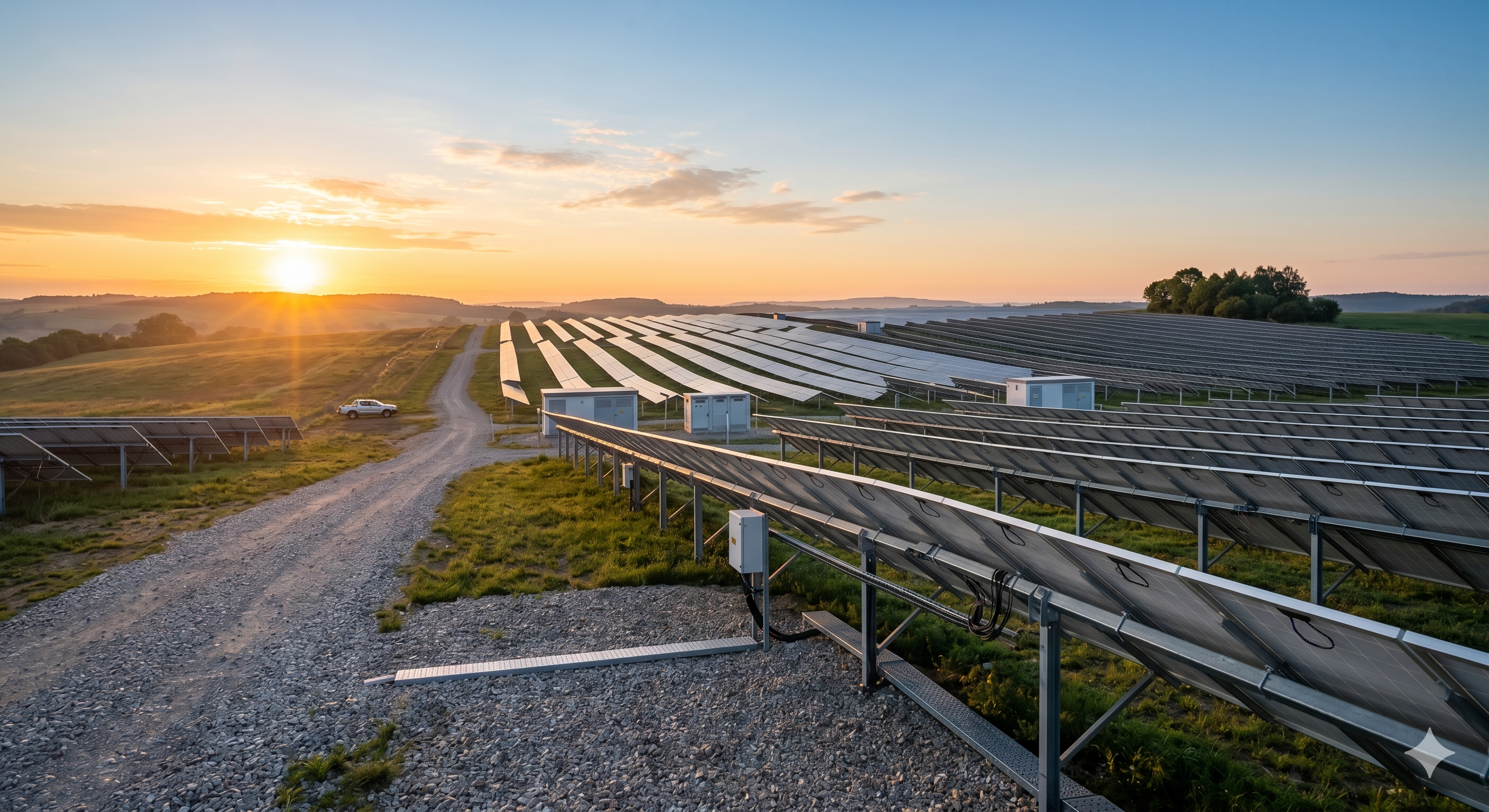
The Renewable Energy Sources (RES) market in Poland is experiencing dynamic growth, with photovoltaic (PV) farms becoming one of the key segments of this industry. However, investments in green energy require a precise assessment of their value. As experts from iCCS in Wrocław, we daily face the challenges of appraising complex assets. Understanding the specifics of photovoltaic farm valuation is absolutely crucial for investors, banks, and developers planning to enter this promising sector. In this article, we will outline the methods and factors influencing the value of these specific properties, with particular emphasis on the realities of the Polish market in 2025-2026.
Specifics of Photovoltaic Farm Valuation: More Than Just Land and Buildings
The valuation of a photovoltaic farm is a much more complex process than appraising a traditional undeveloped or developed property. We are not dealing solely with the value of the land and the structures located thereon. A PV farm is primarily an energy enterprise whose value stems from its potential to generate income from the sale of electricity. Therefore, the appraisal must take into account not only the physical components of the assets (panels, inverters, structures, transformer stations, grid connections) but also rights associated with the property (e.g., ground lease), legal and administrative conditions, and above all, the stability and predictability of future revenue streams.
Characteristic features of PV farms that differentiate them from other types of real estate include the technological nature of the assets, the limited operational lifespan of the installations (panels have a lifespan of about 25 years, though they can still operate at about 85% efficiency after this period), and the legal complexity associated with permits, concessions, and RES support schemes. The value of agricultural land designated for PV farms is also specific, as it involves a change in land use (most commonly classes IV, V, or VI) and potentially its exclusion from agricultural production.
Key Factors Influencing PV Farm Value in 2025/2026
The value of a photovoltaic farm is shaped by a number of variables that a real estate appraiser must analyze in detail. Among the most important, especially in the context of current market trends, are:
- Installed Capacity and Efficiency: The primary parameter determining the farm's production capability. A 1 MWp farm can produce, on average, 1000 to 1150 MWh of energy annually, depending on location and technology. The efficiency of photovoltaic panels is constantly increasing due to technological advancements, for example, through the use of bifacial panels.
- Location: Crucial due to solar irradiance (in Poland, ranging from 950 to 1350 kWh/m² annually) and proximity to energy infrastructure (grid access, connection conditions). The distance from the grid connection point significantly impacts investment costs. Land for PV farms typically consists of undeveloped land or lower-class agricultural land (V and VI).
- Technology: The type and quality of the panels used (e.g., monocrystalline, polycrystalline, perovskite, bifacial), inverters, and monitoring systems influence the efficiency and long-term reliability of the installation. New technologies, such as perovskites, could significantly increase efficiency and reduce energy production costs in the future.
- Legal and Administrative Conditions: Possession of a Local Spatial Development Plan (LSDP) or a zoning decision is crucial. The amendment to the Spatial Planning and Development Act from 2025 introduced an LSPD requirement for large farms exceeding 500 kW, which significantly impacts the investment process. Environmental decisions and building permits are also essential.
- Energy Sales Agreements (PPAs, RES auctions): Revenue stability is often guaranteed by the RES auction system (operating in Poland until 2027), which ensures a fixed energy purchase price for a specified period (e.g., 15 years). Power Purchase Agreements (PPAs), allowing for direct energy sales to end-users, are also gaining increasing popularity.
- Operational and Maintenance (O&M) Costs: Annual operating costs for a 1 MW farm can range from PLN 50,000 to PLN 60,000 net. These include ground lease (PLN 8,000 to PLN 25,000 per hectare annually), servicing, insurance, taxes (agricultural or real estate), monitoring, and potential decommissioning costs.
- Financing and Support Schemes: The possibility of utilizing subsidies, green loans, or tax incentives influences the profitability of the investment.
Valuation Methods Applied in Real Estate Appraiser Practice
In accordance with the Polish Real Estate Valuation Standards (PVS), a real estate appraiser employs various valuation approaches and methods. For photovoltaic farms, due to their income-generating nature, the Income Approach is predominant, although it is sometimes supplemented by the Cost and Comparative Approaches.
Income Approach (Discounted Cash Flow – DCF method)
This is the most commonly used method in photovoltaic farm valuation. It involves forecasting future cash flows generated by the farm (from energy sales) and discounting them to their present value. The analysis takes into account:
- Revenues: Depend on the volume of energy production (MWh) and its selling price (PLN/MWh). SPOT prices on the Polish energy market in September 2025 amounted to EUR 106.93/MWh, while the average electricity selling price on the competitive market in 2025 was approximately PLN 458.24/MWh. Forecasts for 2026+ indicate price stabilization or growth.
- Operating Costs: Include ground lease, maintenance, servicing, insurance, taxes, and administrative costs.
- Capital Expenditure (CAPEX) and Project Preparation Costs: At the outset of the investment, a 1 MW farm costs approximately PLN 2.2-3.1 million net. Costs related to grid connection, which can be substantial, must also be considered.
- Discount Rate: Reflects investment risk and cost of capital.
The profit method, a variation of the income approach, is also applicable when determining the value of income-generating properties whose business activity is closely linked to their specialized nature, such as photovoltaic power plants.
Cost Approach
This approach is primarily used to determine the reproduction cost or replacement cost. It involves estimating the costs to reproduce or replace the photovoltaic farm, taking into account physical deterioration and functional obsolescence. It is useful when market data for the comparative approach is unavailable or when the valuation objective is, for example, to establish an insured value. Construction costs for a 1 MW installation itself typically range from PLN 2.45-2.5 million net, excluding grid connection.
Comparative Approach
Used when transactional data for similar photovoltaic farms is available. In practice, however, due to the uniqueness of individual projects (differences in capacity, technology, location, legal status, support schemes), finding sufficiently comparable properties is often difficult. In the case of valuing land for a photovoltaic farm at an early stage of investment (before entering into a lease agreement or construction), the comparative approach may be more appropriate for determining the market value of the land itself.
The Role of the Real Estate Appraiser and Formal Aspects of Valuation
Professional valuation of a photovoltaic farm requires specialized knowledge in real estate, energy, law, and finance. A real estate appraiser, possessing professional qualifications, is the only person authorized to prepare appraisal reports, which are official documents.
An appraisal report for a photovoltaic farm should contain a detailed analysis of all key factors, as well as a justification for the methods and assumptions adopted. It is an indispensable document in many situations, such as:
- Securing Bank Liabilities: For banks financing RES investments.
- Purchase/Sale Transactions: Helps establish a fair price and negotiate terms.
- In-Kind Contributions to Companies: When contributing a farm as a non-cash asset.
- Financial Statements: For balance sheet purposes.
- Insurance: Determining insurable value.
- Court and Administrative Proceedings: In case of disputes or for tax purposes.
The appraiser must also consider the National Real Estate Valuation Standards (NREVS), which, although mostly good practice recommendations, form the methodological basis for the reports.
Market Trends 2025/2026 and PV Farm Valuation
The photovoltaic market in Poland is rapidly changing. By the end of Q1 2025, Poland already had nearly 22 GW of installed photovoltaic capacity, ranking it 5th in the EU. It is expected that by the end of 2025, the total installed capacity in Poland could reach 26.6 GW, and according to forecasts from the Institute for Renewable Energy, the installed capacity of large-scale photovoltaic farms could reach 10 GW by the end of 2025.
Currently, we are observing a slowdown in the prosumer segment, while the market is increasingly focusing on large-scale photovoltaic farms. A challenge remains in the development of transmission grids to avoid so-called curtailment, i.e., the systemic shutdown of RES due to energy surplus. The importance of energy storage is growing, as it increases investment profitability by allowing for intelligent management of surpluses and independence from market price fluctuations. The first energy from Polish offshore wind farms will flow into the grid in 2026, which will also impact the energy mix and energy prices.
Electricity prices remain high, favoring the profitability of PV farms. New regulations, including the amendment to the energy law passed in March 2026, aimed at, among other things, accelerating RES investments and unlocking thousands of photovoltaic connection applications, are expected to support the further development of the sector.
Summary: Why Professional Valuation is an Investment in Itself?
The valuation of photovoltaic farms is a complex task that requires a holistic view of the property as an income-generating asset, taking into account technical, legal, market, and financial factors. In the face of dynamic changes in the RES market in Poland, where new regulations (such as the LSPD requirement for larger farms) and technological advancements (energy storage, new panel generations) are key, a reliable appraisal report is an invaluable tool.
For an investor, a precise valuation prepared by an experienced real estate appraiser, such as the iCCS team, is not merely the fulfillment of formal requirements. It is, above all, the basis for making informed decisions, securing financing, optimizing risk, and maximizing return on investment. Let us remember that by investing in green energy, we are investing in the future – and a solid valuation is the foundation of that future.